
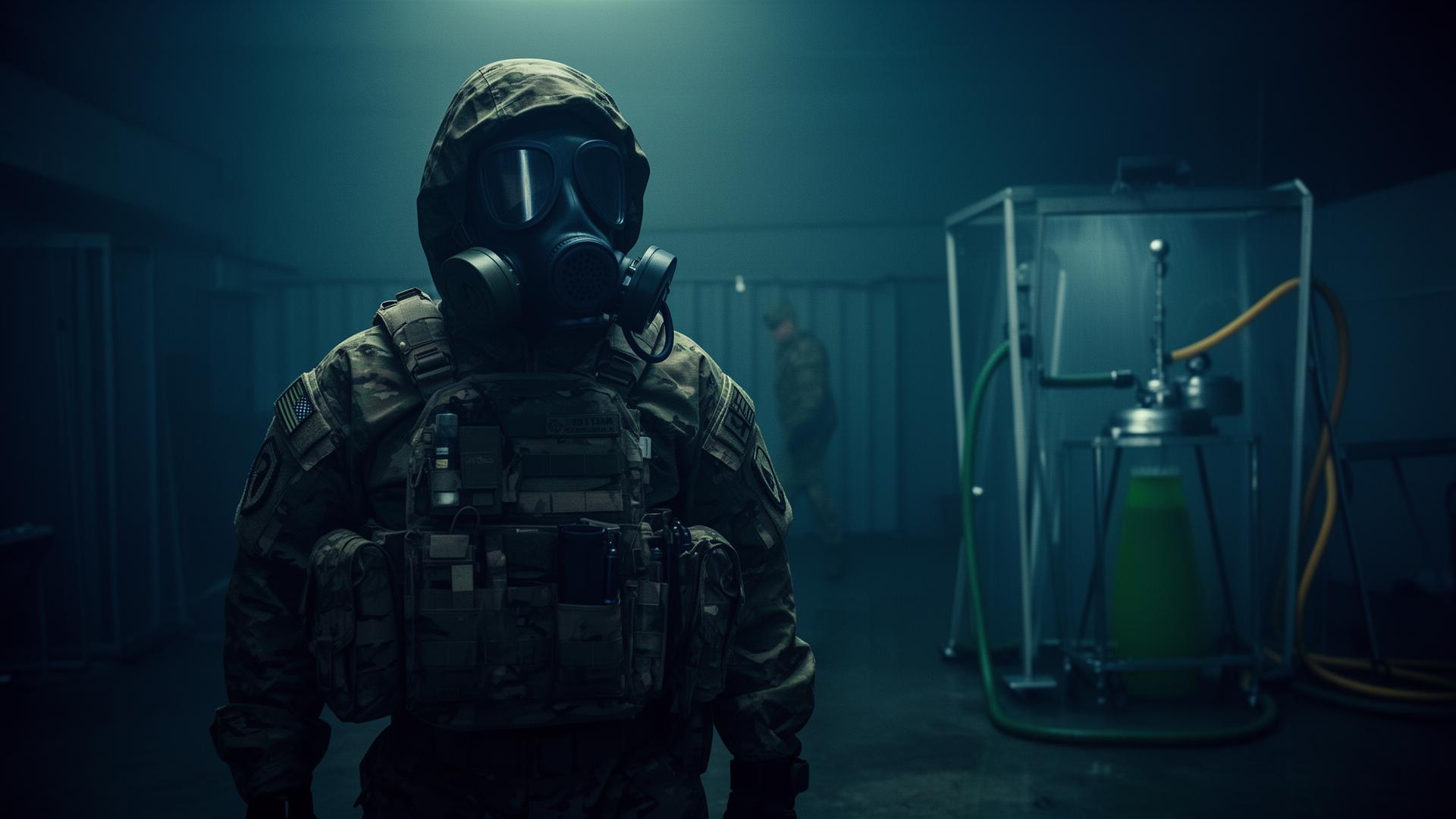
CBRN
Training
Comprehensive CBRN training for Chemical, Biological, Radiological, and Nuclear threat detection, protection, and response. Four-level curriculum built by operators with real-world experience — delivered under CBRN or CBRNe doctrine to match your mandate.
Prepared for the Most Extreme Threats
CBRN training prepares security teams, first responders, and governmental personnel to detect, protect against, and coordinate a response to Chemical, Biological, Radiological, and Nuclear threats. Mission Support delivers structured, scenario-based CBRN training programmes — a four-level curriculum (Awareness, Basic, Advanced, Specialised) whose terminology and exercise design are consistent with NATO CBRN defence doctrine, including AJP-3.8 and its supporting tactical publications.
Our CBRN training is developed by experienced professionals with real-world operational backgrounds in military CBRN units and civil emergency response. Programmes are tailored to the specific environment and risk profile of your organisation.
Training is available for security teams, diplomatic protection staff, first responders, and corporate emergency response teams. We offer both classroom instruction and live practical exercises.
Training Modules
- CBRN Threat Recognition & Detection
- Personal Protective Equipment (PPE) Usage
- Decontamination Procedures
- Emergency Response & Evacuation
- Medical Countermeasures
- Incident Command & Communication
- Chemical Agent Identification
- Radiological & Nuclear Threat Response
- Biological Hazard Protocols
- After-Action Review & Reporting
Four-Level Curriculum
Awareness through Specialised. Each level builds on the one before it, with audience, prerequisites, and operational outcome scoped explicitly. Customers progress staff through the levels that match their role — not beyond.
Awareness
- Audience
- Non-specialist staff in high-risk venues — embassy reception, hospitality desks, executive offices, corporate facilities in CBRN-relevant locations.
- Operational outcome
- Recognise a developing CBRN scenario, raise the alarm correctly, follow venue-specific shelter or evacuation protocols, and stay out of the way of responders.
- Prerequisites
- None.
- Format
- Half-day, classroom + brief tabletop walk-through.
Basic
- Audience
- First responders, in-house security teams, diplomatic-mission protective staff with a likelihood of being on-scene in the opening minutes.
- Operational outcome
- Operate basic detection and PPE correctly, control the scene, perform initial decontamination, hand over cleanly to specialist teams.
- Prerequisites
- Level 01 or equivalent prior CBRN exposure.
- Format
- Two days, classroom + practical exercises in controlled environments.
Advanced
- Audience
- Security teams whose role explicitly includes CBRN response — embassy guards in high-threat postings, corporate emergency-response cells, military or police CBRN sub-teams.
- Operational outcome
- Deliver full-cycle response — agent identification at field level, multi-casualty decontamination, command-coordinated incident management, evidence preservation, post-incident health monitoring.
- Prerequisites
- Level 02 plus operational role with CBRN response in scope.
- Format
- Five days, classroom + practical + tabletop simulations across chemical, biological, radiological, and nuclear scenarios.
Specialised
- Audience
- Designated CBRN response leads, governmental specialist teams, instructors training the levels below. Vetted attendance only.
- Operational outcome
- Command-level decision making in complex multi-agent scenarios, instructor certification (where requested), curriculum delivery to your own teams, classified-adjacent procedure development with the customer's competent authority.
- Prerequisites
- Level 03 plus operational seniority in a CBRN-mandated role.
- Format
- Bespoke programme, scoped per customer. Typically two to three weeks across distributed phases.
What is CBRN Training?
CBRN stands for Chemical, Biological, Radiological, and Nuclear. CBRN training is a structured programme that prepares individuals and organisations to detect threats across all four domains, apply appropriate protection measures, and execute a coordinated response before, during, and after an incident.
The four domains each carry distinct hazard profiles. Chemical threats range from industrial accidents to deliberate deployment of agent classes including choking, blister, blood, and nerve agents. Biological threats include naturally occurring pathogens and weaponised variants — requiring different PPE, containment logic, and decontamination sequences. Radiological threats arise from dirty-bomb scenarios, industrial source accidents, and medical isotope incidents. Nuclear threats — the highest-consequence category — require command-level decision-making frameworks that most organisations will never need but must have on paper.
What makes CBRN training non-trivial is integration. Personnel trained only in one domain often freeze or make category errors when faced with a multi-domain scenario or an ambiguous agent signal. Mission Support's curriculum addresses this through cross-domain tabletop simulations from Level 02 onward, ensuring that the decision logic is portable across scenarios, not siloed by agent type.
Training is scoped to the role, not the organisation. A non-specialist embassy receptionist requires Level 01 Awareness and nothing more. A diplomatic protection officer requires Level 02 Basic at minimum. An in-house emergency-response cell mandated to manage CBRN scenes requires Level 03 Advanced. A governmental specialist requiring command authority in a complex multi-agent incident requires Level 04 Specialised. Mission Support scopes each programme to the audience's mandate, not a generic syllabus.
CBRN vs CBRNe — What's the Difference?
CBRNe extends the original CBRN framework by adding 'e' for explosive. The extension was formalised in NATO doctrine as improvised explosive devices became the dominant delivery mechanism for asymmetric CBRN-adjacent attacks and the primary casualty-generating event in most real-world incidents involving hazardous materials.
In practice, CBRNe acknowledges that most CBRN incidents involving deliberate deployment will include a primary explosive event. An attacker deploying a chemical agent typically disperses it via an explosive device. A dirty bomb combines radiological material with a conventional explosive. Understanding the explosive component — blast radius, fragmentation pattern, secondary ignition risk — changes the first-responder approach significantly. Mission Support's curriculum covers the explosive dimension from Level 02 onward: scene assessment in the opening minutes includes explosion-damage evaluation as a standard step before PPE donning, because premature entry into an unstable blast environment kills responders.
Clients whose policy documentation specifies CBRNe rather than CBRN will find the programme fully compatible. Most buyers using the term 'CBRN training' operate under CBRN doctrine; most military and NATO-aligned customers use CBRNe. The capability difference is minimal — the terminology difference is doctrinal, not substantive.
Decontamination & PPE Training
Decontamination and personal protective equipment selection are taught as an integrated skill set, not as separate modules. Applying wrong-level PPE before an agent is identified wastes response time and risks contamination. Applying correct PPE without understanding the decontamination sequence creates a secondary contamination vector as personnel exit the hot zone.
Mission Support's curriculum covers this integration at every level where it applies. At Level 02 (Basic), participants learn PPE donning and doffing sequences, single-casualty decontamination procedures, and the clean/dirty zone logic that prevents responder contamination during handover to specialist teams. At Level 03 (Advanced), the programme advances to multi-casualty decontamination under field conditions — including triage at the decontamination point, gross decontamination sequencing for ambulatory and non-ambulatory casualties, and coordinating the decontamination corridor while maintaining command communication with clean-side leadership.
PPE selection is agent-class specific. The programme covers CBRN respiratory protection, full encapsulating suits for the highest-contamination scenarios, and the partial-protection equipment appropriate for responders operating at the perimeter of a declared CBRN incident. Making the correct selection under time pressure and with incomplete information — which is the standard operating condition in the opening minutes of a real incident — is precisely what the Level 02 and Level 03 practical exercises are designed to build.
Training Formats
Classroom Theory
Structured lectures covering CBRN threat types, agent properties, detection methods, and legal frameworks.
Practical Exercises
Hands-on scenarios using training equipment and simulated environments to build real-world response skills.
Tabletop Simulations
Command-level exercises testing decision-making, coordination, and communication during a CBRN incident.
Scenario-Based Exercises
Scenarios are the stress test that separates knowledge from capability. Mission Support designs each scenario around the client's actual operating environment — not a generic template — and calibrates difficulty to produce at least one decision point where performance degrades, because that is the point the after-action review is designed to address.
For a full breakdown of tabletop exercises, live drills, and scenario design, see our guide to CBRN training scenarios.
Chemical Release
Toxic industrial chemical spill, chemical warfare agent deployment at a high-footfall venue, or mail-vector liquid agent at a government facility. Tests detection speed, PPE selection under time pressure, scene control, and casualty decontamination.
Biological Incident
Suspicious white-powder letter, biological agent in a ventilation system, or delayed-detection outbreak investigation. Emphasises the ambiguous early-indicator problem and protective action under uncertainty.
Radiological Event
Abandoned source discovered in a public space, improvised radiological dispersal device (dirty bomb) detonation, or industrial source accident. Tests radiation survey procedure, dosimeter management, and cordon calculation.
CBRNe Combined Threat
Explosive delivery of a chemical or radiological agent — a combined-threat scenario requiring simultaneous blast-damage assessment and CBRN detection, with PPE and casualty-management priority conflicts built in.
Multi-Agency Command
Large-scale incident requiring coordination with civilian emergency services, national CBRN assets, and medical reception. Tests command decision-making, situation reporting, and escalation procedures under a degraded information picture.
Vetted Training Provider — What Makes Mission Support Different
CBRN training is a credentialed-instructor market. The quality of a programme is determined entirely by the operational depth of the professionals who designed it. Classroom CBRN knowledge derived from publicly available doctrine is insufficient — instructors must have been responsible for CBRN response decisions in conditions where the consequences of error were real.
Mission Support's curriculum was designed and is delivered by professionals with operational backgrounds in military CBRN units and civil emergency response organisations. The four-level structure mirrors the credentialing architecture used in governmental CBRN programmes — Awareness, Basic, Advanced, Specialised — because this structure reflects genuine capability progression, not arbitrary course packaging.
Programmes are tailored to each client's operational environment and threat profile. A corporate client in pharmaceutical logistics receives different scenario emphasis than a diplomatic mission in a high-threat posting. The agent classes prioritised, the decontamination procedures emphasised, and the command-level decision frameworks modelled all reflect what the client will actually face — not a generic average.
NATO-friendly engagement structure: Mission Support operates exclusively with clients whose operational context is compatible with NATO-aligned frameworks. This creates a verified baseline for information-sharing and, at Level 04, for classified-adjacent procedure development and integration with national CBRN response systems. Vetted access at Level 04 is enforced — programme content at Specialised level is not published and not available without client verification.
Mission Support CBRN — our dedicated CBRN practice
CBRN training, consulting and detection equipment are delivered by Mission Support CBRN, a dedicated practice within Mission Support. The full training catalogue, equipment range and CBRN knowledge base are published there.
Visit Mission Support CBRNFrequently Asked Questions
Related Resources
CBRN training scenarios — tabletop exercises, live drills, and scenario design
CBRN decontamination training — procedures, equipment, and drill standards
CBRN military training standards adapted for private and governmental clients
CBRN vs CBRNe — doctrine, capability differences, and when the distinction matters
CBRN PPE levels — protection ratings, selection criteria, and operational use
CBRN response training — protocols, procedures, and command frameworks
Drone counter-measures — counter-UAS detection and mitigation for payload-bearing platforms
Request a Training Programme
We'll design a tailored CBRN training curriculum for your team's specific needs and environment.
Contact Us