
Safety
End-to-end safety management and risk assessment for organisations operating in complex and high-risk environments.
Your Personnel's Safety Is Our Priority
Mission Support provides comprehensive safety management services for organisations operating in challenging environments — from diplomatic missions in high-risk regions to corporate operations in hazardous locations.
We take a systematic approach to safety, beginning with thorough risk and hazard identification, progressing through policy development, and continuing with training, auditing, and incident investigation. Our goal is to protect your most valuable asset: your people.
Our safety professionals bring experience from military, government, and commercial environments, enabling us to develop practical and effective safety solutions that actually work in the field.
Safety Services
- Health & Safety Management Systems
- Risk Assessment & Hazard Identification
- Occupational Health & Safety Audits
- Safety Policy Development
- First Aid & Emergency Response Training
- Fire Safety Planning
- High-Risk Environment Safety Planning
- Incident Investigation & Reporting
- Safety Culture Development
- Regulatory Compliance Support
Operating Environments
Safety programmes have to be calibrated to the environment they will live in. The same toolkit takes a different shape inside an embassy than inside a refinery. Four environments where Mission Support operates frequently.
Diplomatic Missions in High-Risk Regions
- Context
- Embassies, consulates, ambassadorial residences, and diplomatic field offices operating in elevated-threat postings. Safety programmes have to coexist with security postures and host-country regulatory expectations.
- Scope of Work
- Staff H&S, fire-life-safety planning, evacuation and shelter procedures, CBRN-aware drills, residential safety for accompanying family, contractor-management hygiene, third-party access control.
- Deliverables
- Documented H&S management system, scenario-tested evacuation plan, fire risk assessment, training programme for mission staff and locally engaged personnel, incident-investigation protocol aligned to home-country reporting requirements.
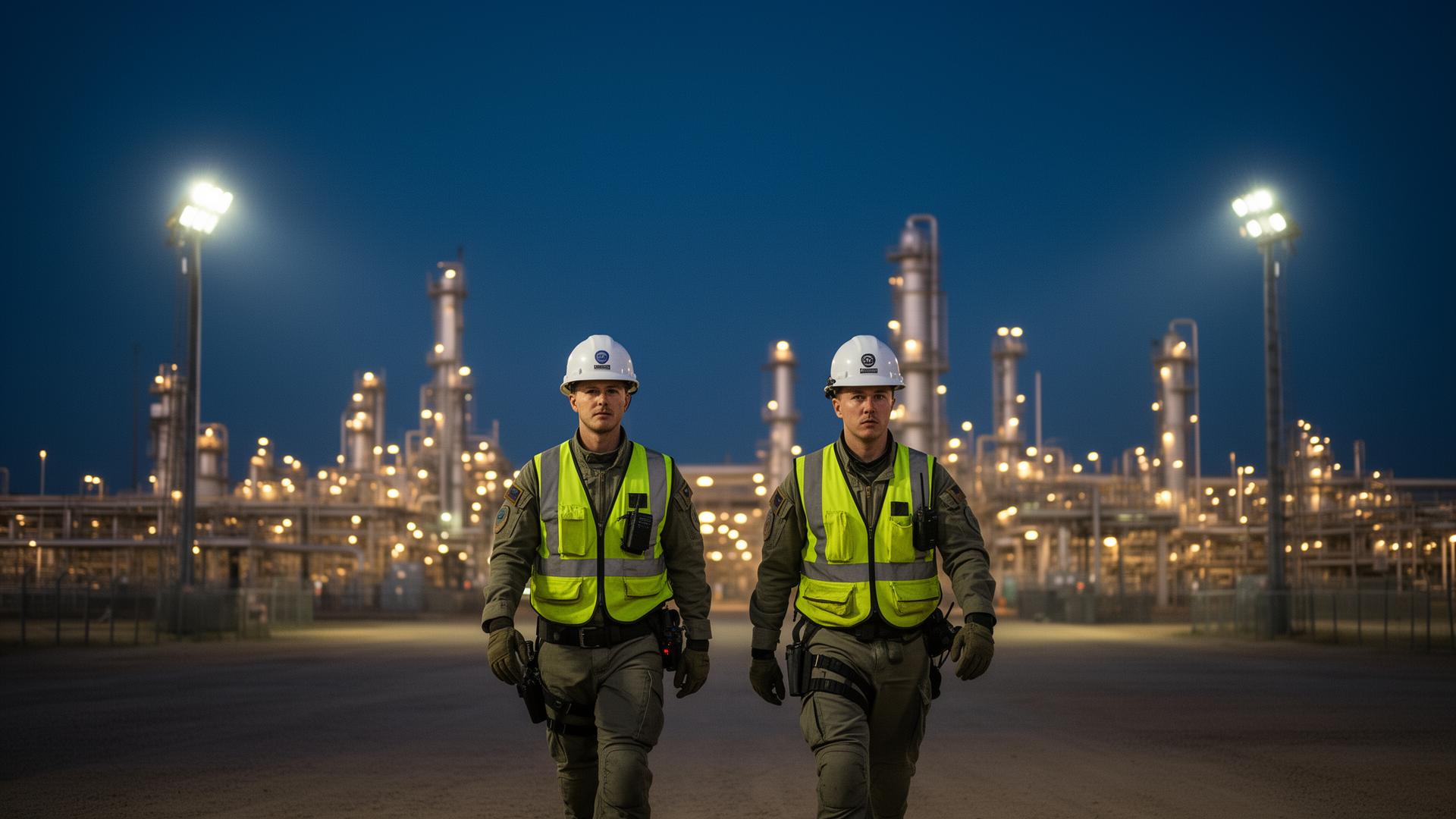
Industrial & OT Facilities
- Context
- Energy, water, transport, manufacturing, pharma, and critical-infrastructure sites where safety failures cascade into operational, regulatory, and reputational events. OT and physical safety converge on the shop floor.
- Scope of Work
- Hazard identification across mechanical, electrical, chemical, and OT domains. Safety policy coordinated with operational integrity. Permit-to-work systems, lockout-tagout, contractor onboarding, near-miss capture, behaviour-based safety culture build.
- Deliverables
- Risk-register against ranked operational impact, control-effectiveness audit, incident-investigation framework with regulator-ready evidence chain, safety-culture diagnostic and intervention roadmap.
Hostile-Environment Operations
- Context
- Corporate, governmental, and NGO teams operating in volatile theatres — post-conflict regions, sanctions-adjacent environments, kidnap-and-ransom-elevated geographies. Staff safety has to work under conditions where normal infrastructure is absent.
- Scope of Work
- Pre-deployment safety briefing, in-country medical posture, journey-management discipline, secure accommodation review, evacuation contingencies, integrated with travel-risk and close-protection postures.
- Deliverables
- Country safety brief, deployment safety pack, scenario drills, emergency communication tree, integrated escalation protocol with the customer's security and medical stack.
Critical-Infrastructure Operators
- Context
- Power, water, telecom, transport, and broadcast operators where safety, security, and resilience are the same conversation. Regulators expect documented programmes; downtime is a national-interest event.
- Scope of Work
- Integrated safety-and-resilience programme covering personnel safety, asset-protection-adjacent procedures, fire safety in mission-critical environments, contractor and supply-chain hygiene, NIS2-aware operational practice.
- Deliverables
- Programme architecture aligned to the customer's regulatory environment (NIS2 / sectoral codes), audit-ready evidence pack, incident-response playbook integrated with operational continuity, executive briefing for regulator engagement.
Our Approach
Assess
We start with a thorough risk and hazard assessment to understand the specific threats and vulnerabilities in your environment.
Implement
We develop and implement practical safety policies, procedures, and training programmes tailored to your operational context.
Monitor
Continuous monitoring, regular audits, and incident review ensure your safety management system remains effective over time.
How a Safety Assessment Is Structured
Site & Threat Survey
Physical walk-through combined with threat-intelligence review for the specific operating environment — embassy compound, industrial facility, or remote deployment area. Outputs a graded hazard inventory.
Risk Register
Hazards ranked by likelihood and consequence against the operational profile. Controls are mapped, gaps identified, and residual risks quantified for decision-makers.
Programme Design
H&S management system, training curriculum, emergency procedures, and audit schedule designed against the risk register — not copied from a template.
Drill, Audit & Review
Scenario-tested drills against the specific hazard profile. Incident investigation protocol activated on any event. Annual audit cycle with regulatory-ready evidence pack.
CBRN Defence Training
Safety programmes in diplomatic and industrial environments include CBRN-aware drills. Mission Support's four-level CBRN curriculum — from Awareness through Specialised — provides the structured, scenario-tested training that backs those drills with real capability.
Where Safety and Security Converge
In high-risk environments, safety and security are rarely separate conversations. Three scenarios where the two disciplines must be planned as one.
CBRN Events at Diplomatic Facilities
A chemical or biological incident at an embassy is simultaneously a safety emergency, a security event, and a host-nation relations question. Personnel without integrated safety-CBRN preparation respond to the most visible threat, not the most lethal one.
Hostile Environment Evacuations
Evacuation under kinetic or near-kinetic conditions requires safety planning — medical posture, route assessment, evacuation drills — to be pre-integrated with security planning. Neither works without the other.
Critical Infrastructure OT Safety
OT/SCADA environments carry physical safety risk that cyber events can detonate. A network intrusion that disables a safety interlock becomes a physical safety incident within seconds. Safety and cyber programmes must cross-reference.
Frequently Asked Questions
Related Resources
Request a Safety Audit
Talk to us about your safety requirements and we'll develop a programme that works for your organisation.
Contact Us