Skip to content
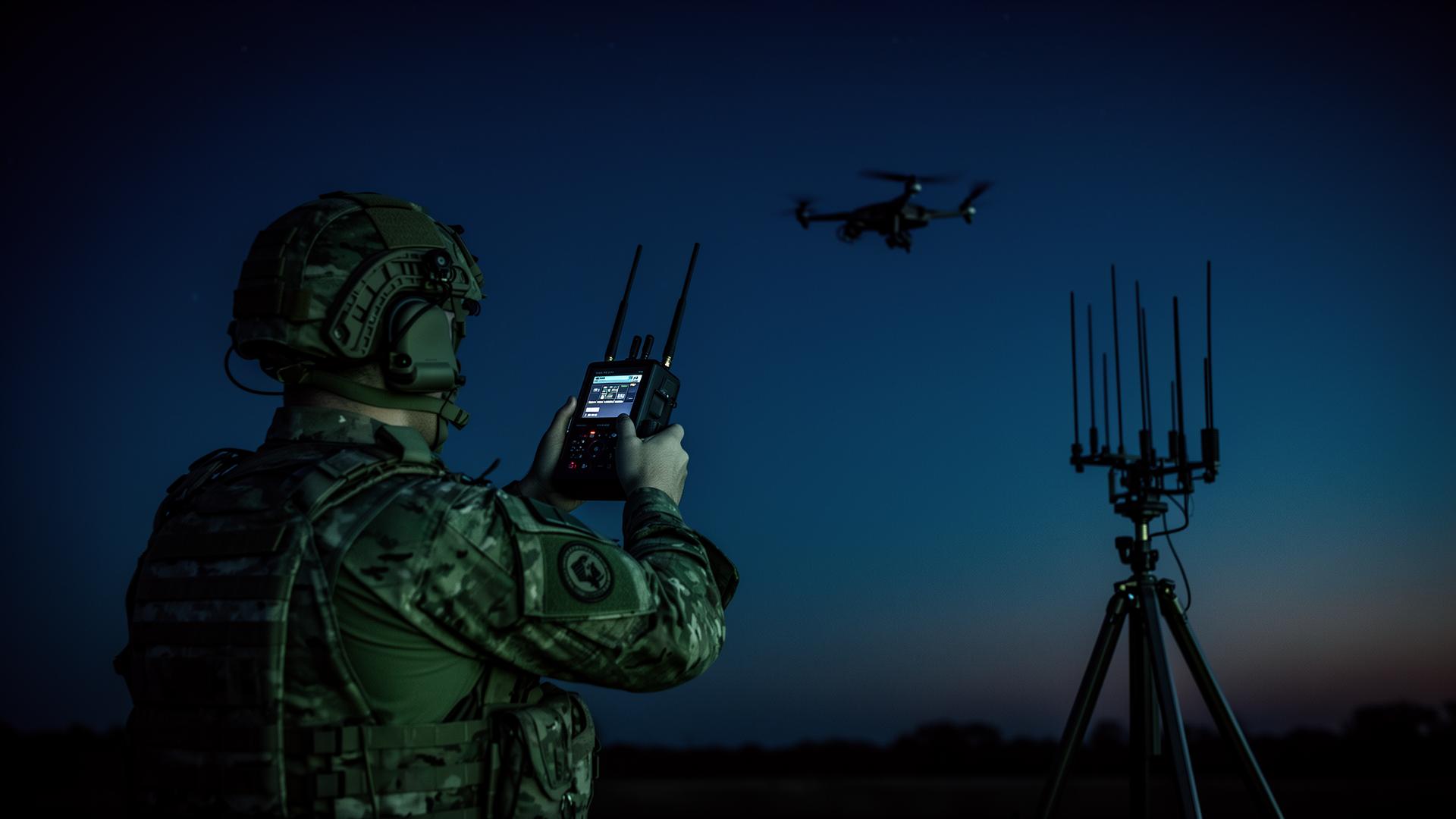
    Counter-UAS operator with RF detection equipment tracking a drone at dusk
    Back to HomeCapability

    Drone
    Counter-Measures

    Detect, deter, defeat. Layered counter-UAS capability against unauthorised aerial threats — surveillance drones, payload-bearing platforms, and hostile reconnaissance assets.

    The Threat

    Commercial UAS now penetrate hardened perimeters with little training and minimal cost. Used as surveillance platforms they expose internal layouts, personnel patterns, and security postures. Used as payload carriers they project kinetic, chemical, or RF effects from beyond the perimeter.

    Counter-UAS is no longer optional for sites of consequence. Mission Support deploys layered detection paired with lawful, environment-appropriate mitigation — built around your jurisdiction, your client base, and your operational constraints.

    Every engagement begins with a site survey, a threat-profile assessment, and a regulatory review. We do not deploy generic kit; we deploy fitted capability.

    Detection

    • RF spectrum monitoring (passive detection of operator-to-drone control links)
    • Radar — small-RCS detection tuned for Class I and II UAS
    • Acoustic sensor arrays for low-altitude, low-RCS targets
    • Electro-optical / infrared (EO/IR) tracking for visual confirmation
    • Sensor fusion — multi-modal correlation to reduce false positives

    Mitigation

    • Defensive RF disruption against control and navigation links
    • Spoofing capability against navigation receivers (jurisdiction-permitting)
    • Capture / net-based recovery for forensic exploitation
    • Hardened comms and protected airspace SOPs for sustained operations
    • Kinetic options where lawfully authorised

    Use Cases

    Critical infrastructure (power, water, telecoms, datacentres)
    Executive estates and high-net-worth residential
    Embassies and diplomatic compounds
    Major events with elevated threat profiles
    Corporate sites with IP-sensitive operations

    Detection Technology — How Each Layer Works

    RF Spectrum Monitoring

    Passive sensors scan the frequency bands used by commercial and military UAS control links. Detection is non-emitting and covert. Modern RF systems can identify drone models from RF fingerprinting and provide bearing to the operator's ground station, enabling law enforcement follow-up.

    Radar — Small-RCS Detection

    Purpose-built counter-UAS radar is tuned to detect the small radar cross-sections of Class I and II UAS — targets conventional air-traffic radar ignores. Provides range, altitude, and track data. Most effective at open sites; performance in urban clutter requires careful placement and tuning.

    Acoustic Sensor Arrays

    Microphone arrays detect the acoustic signature of drone propellers — useful against low-altitude targets in environments where RF detection is constrained by competing emitters. Effective at close range; performance degrades in high-ambient-noise environments.

    Electro-Optical / Infrared (EO/IR)

    Optical cameras and thermal imagers provide visual classification of detected targets — confirming a drone rather than a bird, identifying the drone type, and tracking at close to medium range. EO/IR is confirmation and evidence-capture layer, not a primary detection layer for initial discovery.

    Legal Framework — What Is and Is Not Permitted

    Counter-UAS legality varies significantly by jurisdiction. Active mitigation — RF disruption, spoofing, capture, kinetic — is controlled in most territories. Mission Support conducts a regulatory review as part of every engagement.

    Netherlands & EU

    Active RF disruption (jamming) is classified as intentional radio interference under EU and Dutch telecommunications law and is not lawfully deployable by private parties without specific authorisation. Detection (passive RF, radar, acoustic, EO/IR) is generally permissible. Mission Support works with clients to structure engagements that deploy only lawfully authorised measures and, where appropriate, to pursue the permits or governmental coordination required for active mitigation.

    International Operations

    Jurisdictions vary from permissive (some Gulf states, certain African nations operating under governmental frameworks) to highly restrictive (EU, UK, US for private parties). Mission Support reviews each deployment location individually and will not deploy measures that violate local telecommunications or airspace law regardless of client preference.

    Governmental & Defence

    Governmental and defence clients operating under appropriate legal frameworks may have access to the full mitigation spectrum — including active RF disruption, spoofing, and kinetic options. Mission Support designs and delivers full-spectrum counter-UAS for clients with the legal authority to employ it, under structured rules of engagement.

    Frequently Asked Questions

    What are drone counter-measures?

    Drone counter-measures — also called counter-UAS (unmanned aircraft systems) — are layered detection and mitigation capabilities designed to identify, track, and neutralise unauthorised aerial threats including surveillance drones, payload-bearing platforms, and hostile reconnaissance assets. Mission Support deploys RF, radar, acoustic, and EO/IR detection systems paired with lawful, environment-appropriate mitigation.

    How does Mission Support detect unauthorised drones?

    Mission Support uses a multi-modal detection approach: RF spectrum monitoring detects operator-to-drone control links; radar tuned for small-RCS Class I and II UAS provides range and track; acoustic sensor arrays detect low-altitude targets by sound signature; and electro-optical / infrared (EO/IR) systems provide visual confirmation and classification. Sensor fusion correlates data across modalities to reduce false positives.

    Can counter-UAS capability be deployed for a single event?

    Yes. Mission Support deploys counter-UAS for both fixed sites and time-limited operations — high-profile events, diplomatic conferences, and executive gatherings with elevated threat profiles. Each deployment begins with a site survey, threat assessment, and regulatory review. Configuration is fitted to the environment and threat picture, not drawn from a standard kit list.

    Is active counter-drone technology legal to deploy?

    Active drone mitigation measures are subject to jurisdiction-specific regulation. Mission Support conducts a regulatory review as part of every engagement and only deploys mitigation options lawfully authorised in the relevant territory. We will advise clearly on what is and is not permissible in a given jurisdiction before any deployment.

    What is RF drone detection and how does it work?

    RF (radio frequency) detection passively monitors the electromagnetic spectrum for the control and telemetry links between a drone operator and the drone. Most commercial UAS communicate on known frequency bands — 2.4GHz, 5.8GHz, or proprietary protocols — allowing RF sensors to detect the presence of active control links, estimate direction of origin, and in some cases identify the drone model from its RF signature. RF detection is passive — no emissions — making it suitable for covert counter-UAS operations. Limitations: autonomous drones operating without a live control link produce no RF signature, requiring additional detection modalities.

    What is the difference between counter-UAS and counter-drone?

    Counter-drone and counter-UAS (Unmanned Aircraft Systems) refer to the same discipline — the capability to detect, track, identify, and where authorised mitigate unauthorised aerial threats. 'Counter-UAS' is the preferred military and governmental term, aligned with NATO doctrine. 'Counter-drone' is the common civilian and commercial term for the same capability. Mission Support operates across both military-standard and civilian regulatory environments and uses the terminology appropriate to the client and jurisdiction.

    How does a site survey for counter-UAS work?

    A counter-UAS site survey establishes the physical and electromagnetic baseline of the protected site before any capability is specified. The survey maps the site's RF environment — existing emitters that may mask or interfere with detection systems — and identifies the approach vectors, stand-off distances, and altitude profiles most relevant to the threat. Mission Support conducts site surveys before specifying any detection or mitigation equipment. Sites vary significantly: an urban diplomatic compound has different sensor placement constraints than a rural critical infrastructure node or a temporary high-profile event venue. Capability is fitted to the site, not the reverse.

    Can drones carry CBRN payloads?

    Yes. Commercially available UAS have been weaponised with chemical, biological, and radiological payloads in documented real-world incidents. Even small Class I drones are capable of dispersing liquid or powder agents over an area or delivering a package. This threat profile is one reason Mission Support treats counter-UAS and CBRN preparedness as related capability areas: a site facing a drone threat should have CBRN response procedures that account for payload-bearing platforms, not just surveillance drones.

    What happens after a drone is detected?

    Detection produces a track — position, heading, altitude, and in some configurations the drone model and operator location. The response depends on the authorised mitigation options for the jurisdiction and site. Options include: alerting on-site security to the drone's position; activating defensive RF disruption if authorised; capturing the drone physically for forensic exploitation; coordinating with law enforcement for operator location and prosecution; or in permissive environments, escalating to kinetic response. Mission Support designs the full detection-to-response workflow — not just the sensor layer — as part of every counter-UAS programme.

    How does counter-UAS integrate with existing physical security operations?

    Counter-UAS is most effective when integrated into the site's existing security management structure, not operated as a standalone system. Mission Support wires counter-UAS into the site's command-and-control architecture: drone tracks feed the site security operations centre on the same screen as CCTV, access control, and perimeter sensor feeds. Alert thresholds, response protocols, and escalation procedures are written into the site's security plan and exercised alongside physical security drills. Isolated counter-UAS equipment without integration into the wider security picture produces delayed response and coordination failures.

    CBRN Defence Training

    Drones carrying chemical or radiological payloads are not a theoretical threat. Teams protecting high-value sites need CBRN response capability alongside counter-UAS. Mission Support's four-level CBRN curriculum closes that gap.

    View CBRN Curriculum

    Request a Counter-UAS Consultation

    Tell us about the site and we will scope a counter-UAS programme matched to threat, jurisdiction, and operational tempo.

    Contact Us